What the ToD Rules Say
- The Ministry of Power notified the Electricity (Rights of Consumers) Amendment Rules, 2023 on 14 June 2023.
- ToD tariff for Commercial and Industrial consumers with a maximum demand above 10 kW was to be made effective not later than 1 April 2024. For other consumers, except agricultural consumers, the date was 1 April 2025.
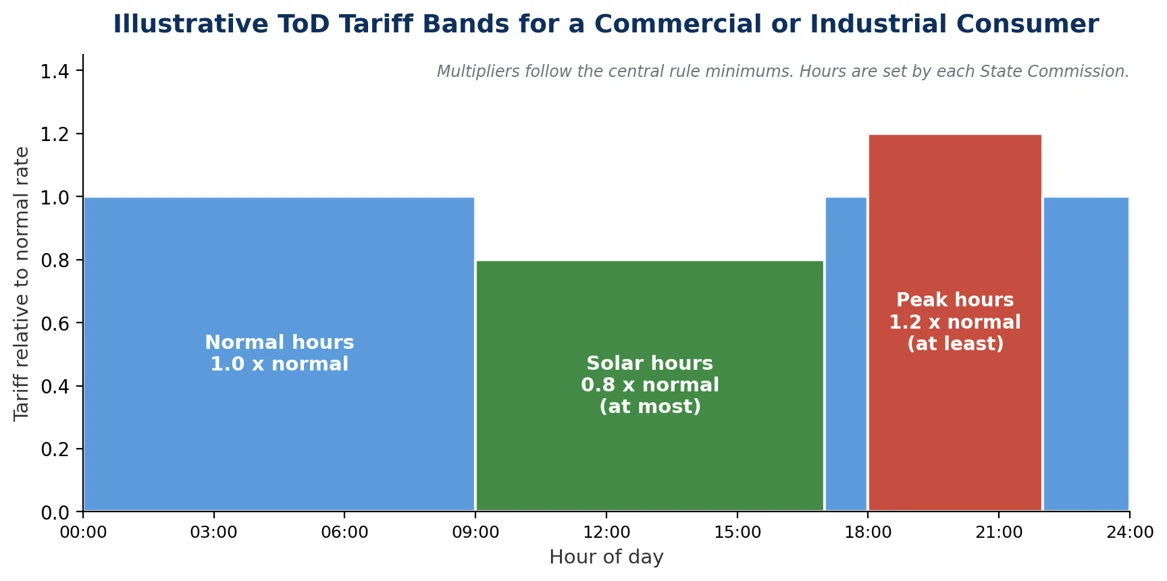
- During the peak period, the tariff for Commercial and Industrial consumers must be at least 1.20 times the normal tariff. For other consumers the minimum is 1.10 times.
- The tariff for solar hours, as specified by the State Commission, must be at least 20% lower than the normal tariff.
- The State Commission decides the timings of each period, so hours differ from state to state.
These points are taken from Press Information Bureau release on Tod Rules. Many states already had ToD tariffs for large industrial consumers before these rules, so the structure may already appear in your tariff order. The central rules set minimum differences. The tariff order for your state and consumer category is the final reference, and it should be checked for the current bands and rates.
A Worked Cost Example
Take a normal energy charge of ₹10 per kWh. This is an assumed figure for illustration, and it excludes demand charges, fuel adjustment and duties. Using the rule minimums, the peak rate is at least ₹12 per kWh and the solar-hours rate is at most ₹8 per kWh.
A process that consumes 100 kWh each day costs ₹1,200 if it runs in peak hours, ₹1,000 in normal hours and ₹800 in solar hours. Moving it from peak to solar hours saves ₹400 per day, which is about ₹12,000 over a 30-day month for a single 100 kWh process.
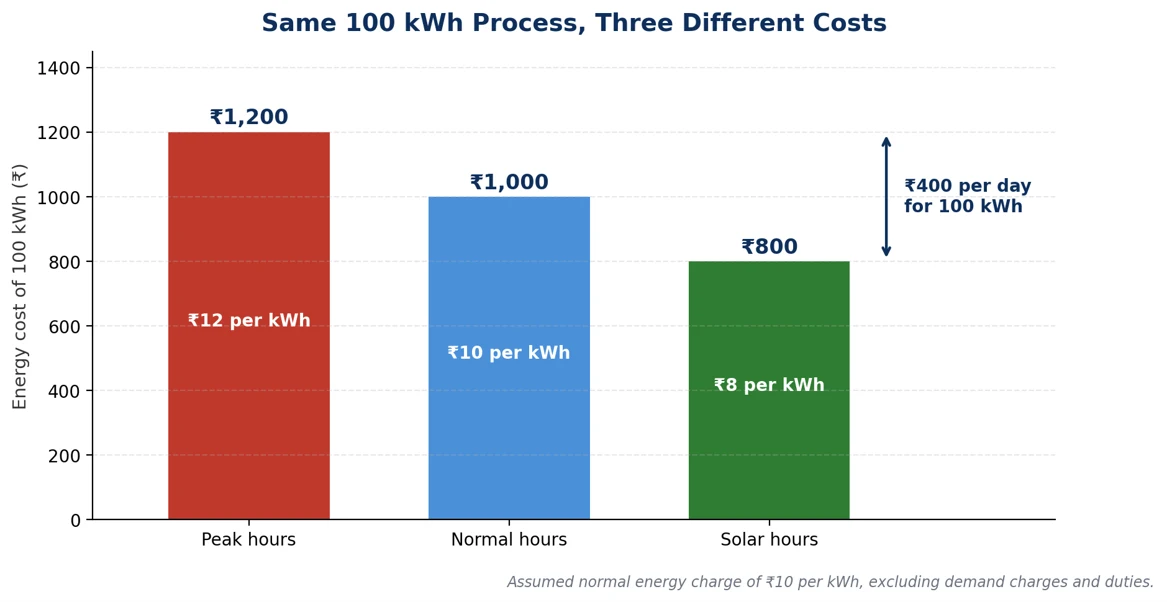
The saving scales with the size of the shiftable load. A plant with 2,000 kWh per day of shiftable consumption would see a difference of ₹8,000 per day, or about ₹2,40,000 per month, at the same rates.
Which Loads Can Be Shifted?
| Often shiftable | Usually fixed |
| Batch processes with flexible start times | Continuous process lines |
| Pumping into storage tanks | Loads tied to customer orders or shift schedules |
| Battery and forklift charging | Safety-critical systems |
| EV fleet charging | Equipment with strict process temperature or timing limits |
| Thermal storage and pre-cooling | Loads that cannot be paused without scrap or restart losses |
Why ToD Is Hard to Manage Without Asset-Level Data
- The bill is too late and too broad. The DISCOM bill shows consumption by ToD band for the whole connection. It does not show which machine used the energy, and it arrives after the billing cycle has closed.
- The biggest consumer is not always the costliest. A smaller load that runs mainly in peak hours can cost more than a larger load that runs mostly in solar hours.
- Shifting load can create a new demand peak. If several processes are moved to start together at the beginning of the solar window, the maximum demand in that block can rise and cross the contract demand, where penal charges may apply. Load shifting and demand management need to be planned together.
- Tariffs change. Hours and multipliers change when the commission issues a new tariff order, so any comparison with an earlier month has to use the tariff that applied at that time.
Steps to Reduce ToD Cost
- Read the tariff order. Note the peak, normal and solar hours, the multipliers and any seasonal differences for your state and consumer category.
- Build the load profile by band. Split monthly consumption into peak, normal and solar kWh for the whole plant, and then for each feeder.
- Find the loads running in peak hours. Rank assets by their consumption inside the peak window, not by their total consumption.
- Decide what can move. Work with production and maintenance teams to find which start times are flexible and which loads can be staggered.
- Set a demand alert first. Before shifting, set an alert at around 95% of contract demand so that the new load pattern does not create a penal demand block.
- Verify with a shadow bill. Compare the cost by band before and after the change, priced on the same tariff.
- Review every quarter. Production patterns, loads and tariff bands change, so the plan needs regular review.
How ESIQ Supports ToD Cost Control
Energy Saver IQ (ESIQ) prices metered consumption through the plant’s own tariff order, including its time-of-day windows, so the cost by band is available in rupees and not only in kWh. The weekly and quarterly diagnostic reports identify time-of-day exposure. The quarterly report turns it into recommended actions, each with a criticality, an owner role, a timeframe and an estimated cost.
The Energy Meter View and Trend screens show load patterns and consumption by feeder, and the platform derives shift-wise consumption, load profile and top consuming assets from the same data. An alert set against contract demand, routed by shift to the users assigned to that asset, protects the plant from creating a demand penalty while it shifts load.
Tariff versions are retained, so a report for an earlier month is recalculated on the tariff that applied then. Where a tariff or invoice has not been supplied, the commercial pages are left out instead of being filled with assumed figures.
Common Mistakes
- Assuming that the peak window is the same in every state or for every consumer category
- Treating total kWh as the target instead of kWh in peak hours
- Moving load without checking the effect on maximum demand
- Comparing against last year’s bill using the current tariff
FAQs
- What is ToD tariff?
ToD (Time of Day) tariff is a pricing structure in which the rate per unit depends on the time at which electricity is consumed, with higher rates in peak hours and lower rates in solar hours. - Who does ToD tariff apply to?
Under the 2023 central rules, ToD tariff applies to Commercial and Industrial consumers with a maximum demand above 10 kW, with an effective date not later than 1 April 2024. Implementation follows the order of the State Commission. - What are the peak hours under ToD tariff?
Peak hours are fixed by each State Electricity Regulatory Commission, so they differ between states. The tariff order for your state gives the current timings. - How much higher is the peak-hour rate?
The central rules require the peak-period tariff for Commercial and Industrial consumers to be at least 1.20 times the normal tariff. The actual multiplier is given in the state tariff order. - How can an industry reduce ToD tariff cost?
Identify which assets consume the most energy inside the peak window, move or stagger flexible loads into normal or solar hours, and set a demand alert so that the shift does not create a demand penalty.
To see how ESIQ prices your consumption by tariff band and identifies peak-hour exposure, get in touch with our team. Write to us at digital@motwane.com or call +91 91564 61052.