What exactly a Busbar is?
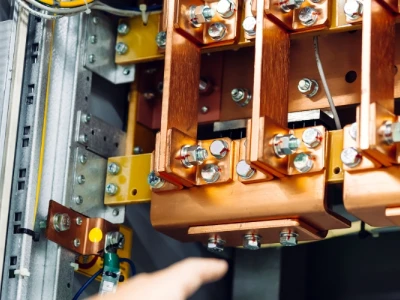
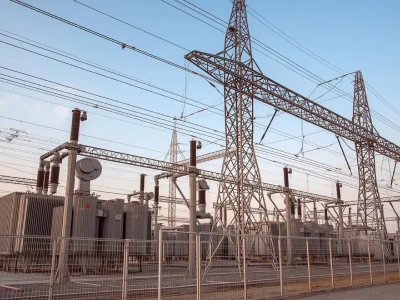
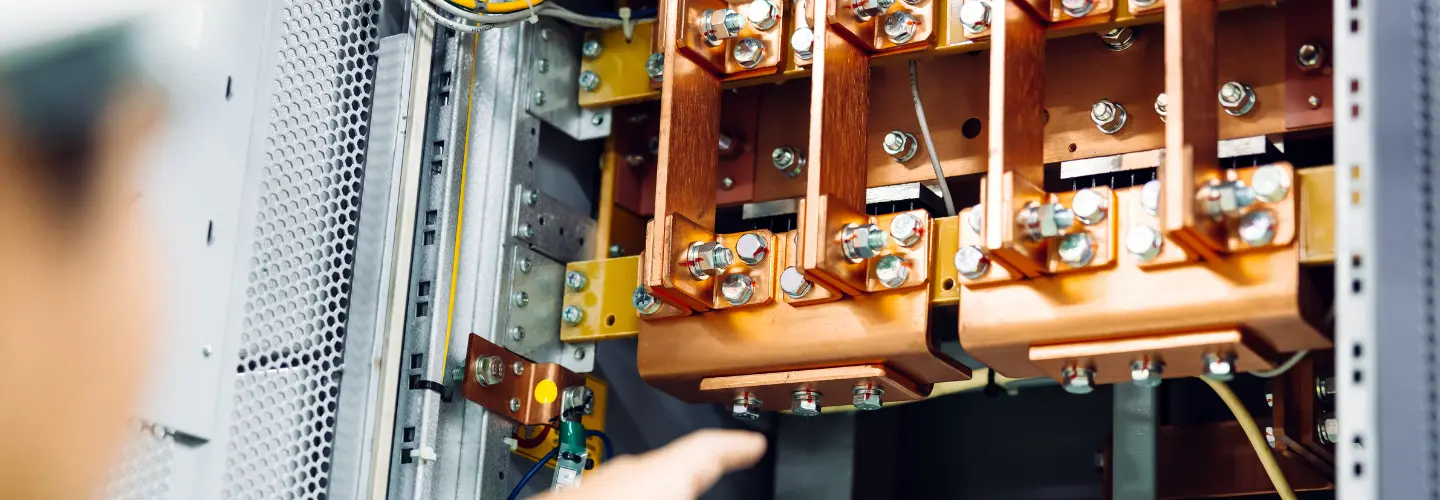
A busbar is a flat conductor strip (copper or aluminum) that carries hundreds or thousands of amps from varying power sources to multiple outgoing circuits in a switchgear, panel, or substation. It resembles like a super-efficient highway for electricity. Unlike cables that twist, heat up, and lose energy through resistance, a busbar’s large cross-sectional area provides a low-impedance path for electricity flow.
It conducts power from generators, transformers, or feeders and distributes to breakers, loads, and downstream equipment. Busbars are more efficient than the traditional cablings as these handles high currents with minimal voltage drop and have better heat dissipation.
Use of Busbars are very common in:
- Industrial switchgear and motor control centers
- Data centers and commercial buildings
- Renewable energy setups (solar inverters, wind farms)
- High-rise busbar trunking systems
Why Busbar Monitoring Is Critical in Modern Electrical Distribution Systems?
Modern power systems work under more pressure than ever these days. They handle higher loads, integrate unpredictable renewable energy, and must also meet strict efficiency and safety standards. At the center of these power systems are busbars, which are always hidden inside enclosures and where issues can develop quietly which may go unnoticed.
Key reasons monitoring has become essential:
- Early detection of thermal issues: Loose connections, corrosion, or overloads cause localized heating. Real-time monitoring detects these “hotspots” in real time.
- Preventing cascading failures: In distribution networks, one failing joint can trip devices across sections or even shut down entire facilities. Continuous Monitoring of Busbars enables selective and predictive intervention.
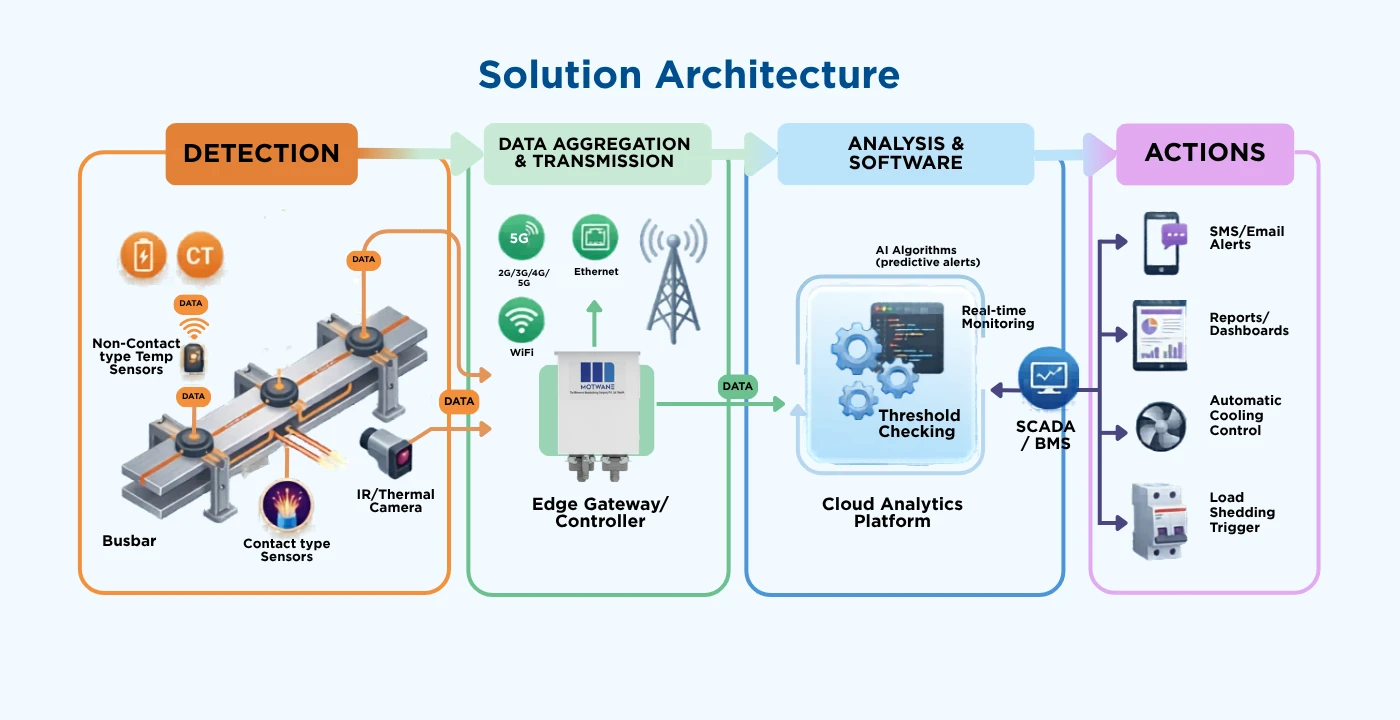
- Supporting Industry 4.0 and smart grids: To work smart modern systems use IoT, SCADA, and cloud analytics. They track temperature alongside load current, predict when maintenance is required, and helps to optimize how energy flows. This is especially important for facilities that aim for net-zero goals or monitor harmonic-heavy loads from VFDs (Variable Frequency Drives).
- Safety and compliance: Arc flash risks, fire hazards, and personnel exposure during manual inspections drops with remote, non-intrusive sensors (wireless or fiber-optic). Many systems now meet standards for continuous thermal surveillance in high-voltage environments.
Difference Between Busbar Monitoring and Traditional Panel Monitoring
| Aspect | Traditional Panel Monitoring | Busbar Monitoring |
|---|---|---|
| Focus Area | Overall panel performance (big picture) | Specific focus on busbars, joints & conductors |
| Primary Parameters | Voltage, Current, Power Factor, Energy Consumption, Circuit Breaker Status, Trip Events | Granular Temperature at multiple joints, Current distribution across phases, Optional: Vibration & Insulation health |
| Monitoring Level | Panel-level or Feeder-level | Component-level (busbar joints are the weakest links) |
| Sensors Used | CTs (Current Transformers) + Multifunction Meters | Wireless/Non-contact sensors (Infrared, Fiber Optic, etc.) |
| Granularity | Detects overloads or issues at feeder/panel level | Pinpoints exactly which joint or section is overheating |
| Response Time | Periodic (relies on manual thermography or scheduled checks) | Real-time 24/7 monitoring with instant alerts |
| Predictive Capability | Mostly descriptive (tells you “what” is happening) | Highly predictive – uses AI/ML to forecast failures |
| Installation | Usually integrated during panel manufacturing | Retrofit-friendly, non-intrusive, minimal downtime |
| Safety | Requires opening panels for detailed checks | Safe for live enclosures – no additional conductive paths |
| Blind Spots | Many (internal joint issues often go unnoticed) | Minimal – direct visibility into critical connection points |
| Analogy | Like checking your car’s dashboard gauges | Like having temperature & vibration sensors directly on the engine block and exhaust manifold |
Real-world failure modes include:
- Loose connections (vibration or thermal cycling)
- Corrosion or contamination
- Overloading beyond design limits
- Mechanical stress or poor initial installation
- Most factors escalate slowly enough for a smart monitoring system to catch them early.
How Busbar Failures Impact Industrial Energy Efficiency and Safety
Busbar problems are rarely visible at initial stage. They simmer, then escalate and the impacts are both costly and dangerous.
On Energy Efficiency:
Increased resistance from loose bolts, oxidation, or poor contacts turns electrical energy into unwanted heat. This raises overall system losses—sometimes significantly in high-current setups.
Overheating forces derating (running equipment below capacity) or causes inefficient load distribution across phases.
In severe cases, failures lead to unplanned downtime, where backup generators or rerouted power run less efficiently. Studies and field data show that well-maintained busbar systems can contribute to measurable reductions in transmission losses compared to overloaded or degraded alternatives.
On Safety:
Thermal runaway and arcing: Hot joints can degrade insulation which may lead to phase-to-phase or phase-to-ground faults. This risks arc flash events releasing intense energy that can injure personnel or destroy equipment.
Fire hazards: Overheating connections or joints are ignition source in industrial environments.
Personnel risk: Traditional inspection often requires opening live panels, exposing technicians to hazards. Continuous monitoring reduces this need.
Broader consequences: A single busbar failure in a critical facility (data center, manufacturing line, hospital) can cascade into blackouts, equipment damage, production halts, and regulatory violations.
Benefits of Busbar Monitoring for Global Industries
- Reduced unplanned downtime and maintenance costs
- Extended asset life for switchgear and busbars
- Improved energy optimization and sustainability reporting
- Enhanced compliance with safety and efficiency standards
- Scalability for everything from small panels to large substations
Facilities adopting these systems report earlier fault detection, safer operations, and better ROI through prevented losses.
Adapting Busbar Monitoring
If you’re new to this, begin with a risk assessment of your highest-load or most critical busbars. Look for systems like Busbar IQ that offer easy integration, reliable wireless tech, and clear analytics. Have a check for environmental factors (dust, humidity, voltage level), will help in sensor choice. Busbar monitoring is more than a gadget, it is a strategic system that makes your entire electrical distribution smarter, safer, and more efficient.