What “Online” Actually Means Here
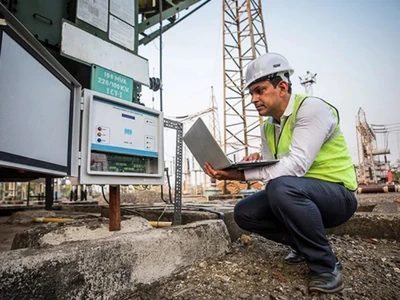
An online transformer monitoring system isn’t just a system with an internet connection. It’s a system where the sensors themselves stay physically attached to the transformer and take readings on their own schedule, often every few seconds or minutes, without anyone visiting the site.
Compare that to the traditional approach: an oil sample gets pulled once a quarter or once a year and sent to a lab, or a technician runs a portable test set during a scheduled outage. Both of those still have their place. Neither one tells you anything about the days or weeks in between visits, and that gap is exactly where most developing faults spend most of their life before they become serious.
How an Online System Is Actually Built
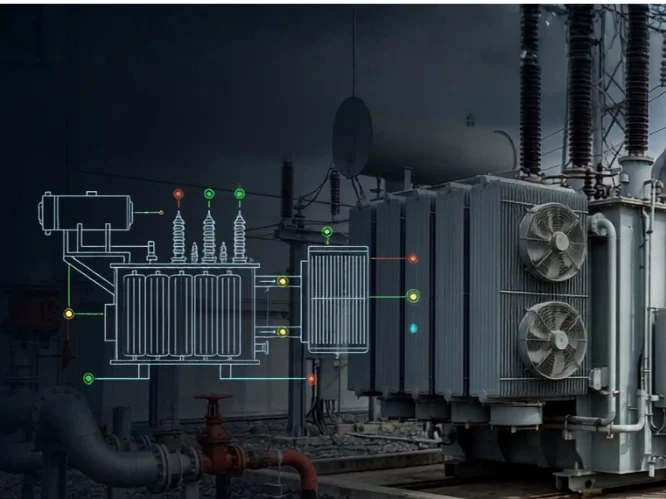
Underneath the dashboard, an online transformer monitoring system is really four layers working together.
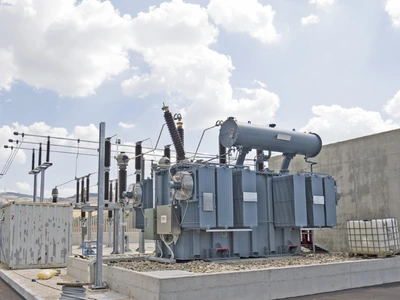
Sensors sit on or inside the transformer itself, measuring things like winding temperature, load current, dissolved gas concentration, or vibration. Depending on the parameter, these might be fiber optic probes, current transformers, gas sensors, or accelerometers.
A gateway sits near the transformer and does two jobs: it pulls readings in from every connected sensor, and it handles the first layer of processing before anything leaves the site. This matters more than it sounds. A gateway that can flag an obvious anomaly locally, rather than shipping every raw reading to the cloud and waiting for a response, keeps the system responsive even if connectivity briefly drops.
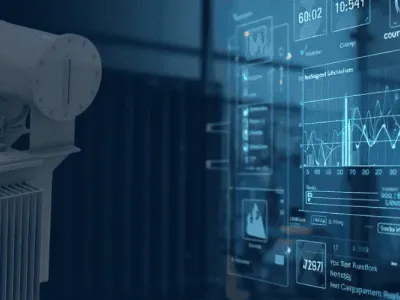
From there, data moves to a cloud platform, where it gets compared against the transformer’s own history and against the thresholds and weightings drawn from standards like IEEE, IEC, and CIGRE guidance. This is also where readings from different parameter families get correlated. A gas trend on its own is one data point. A gas trend that lines up with a thermal anomaly and an electrical signature is a much stronger case for actually doing something(which can be then made into actionable recommendations for better operational efficiency).
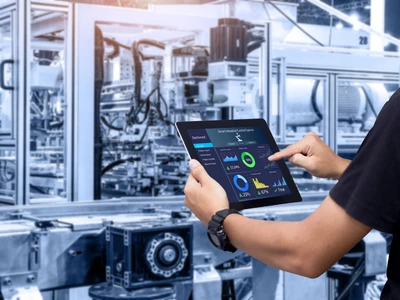
The last layer is the part people actually interact with: dashboards, trend charts, and alerts sent by whatever channel reaches the right person fastest, whether that’s email, SMS, or a control room display.
What Real-Time Data Catches That Periodic Testing Misses
The practical value of going online shows up most clearly in how fast a problem can actually develop. Dissolved gas levels can climb meaningfully within days under the right fault conditions, well inside a single quarterly sampling interval. A load-driven hotspot can build and ease off entirely within a single production shift, in a pattern a once-a-year thermal survey would never happen to catch at the right moment.
Online monitoring doesn’t just take the same measurement more often. It captures the shape of a trend, not just a single point on it. A rising DGA reading that’s still within a generic “normal” range can be a clear warning sign if it’s risen steadily for three weeks. A snapshot test has no way to show that shape at all.
Connectivity Options for Online Monitoring
Getting data off the transformer and into the system usually comes down to a handful of options, and the right one depends on the site more than the technology.
Cellular connectivity (2G through 4G, depending on what’s available locally) works well for remote substations or plants without existing network infrastructure, since it needs nothing more than a SIM and reasonable signal coverage.
Ethernet is the more reliable option where a plant’s own network already reaches the transformer yard, offering more consistent bandwidth without relying on carrier coverage. Wi-Fi sits in between, useful where running a cable is impractical but cellular coverage is unreliable indoors or in shielded structures.
Most gateways built for industrial environments support more than one of these, so a site isn’t locked into a single connectivity path if conditions change later.
Data Security in an Online System
Putting a transformer’s operating data on a network naturally raises a security question, and it’s a fair one to ask. Industrial monitoring platforms built for this environment typically rely on end-to-end encryption (commonly AES-256) for data in transit, along with OTP-based authentication to control who can actually access the platform.
Security in this context isn’t a separate feature bolted on afterward. It has to be part of how the gateway and cloud layers are designed from the start, since a monitoring system that creates a new attack surface on plant infrastructure would defeat its own purpose.
Addressing the Common Objections
A few concerns come up often enough to be worth answering directly.
Isn’t this expensive compared to periodic testing? The upfront cost is real, but it has to be weighed against the cost of what periodic testing misses. A single avoided unplanned outage, on a transformer feeding a continuous process, typically covers the cost of monitoring many times over.
Does this replace lab-based DGA testing entirely? Not usually, and it shouldn’t be expected to. Online DGA sensors are excellent at catching trends and sudden changes, but periodic lab samples, run on the full multi-gas panel with an accredited lab, still serve as a useful cross-check and calibration point.
Is it complicated to retrofit onto existing transformers? Less than most people assume. Wireless, battery-powered sensor options exist specifically to avoid the wiring runs that used to make retrofits impractical, and most add-on sensors integrate through the same gateway rather than requiring a separate system per parameter.
Conclusion
“Online” is a simple word doing a lot of work here. It’s the difference between checking on a transformer once in a while and actually watching it. The sensors, the gateway, and the cloud analysis all matter, but the thing that actually changes outcomes is continuous data replacing a snapshot, so a developing problem gets caught somewhere in the middle of its progression instead of at either end.
Technical Savings
- Potential Downtime Savings
- Potential Asset Life Increment
- Potential Efficiency Increment
TXIQ runs on exactly this architecture, continuous sensing, edge processing, and cloud-based health monitoring, built for both power and rectifier transformers on a single platform.