What is Demand Side Management?
Demand Side Management involves essential measures to affect and transformer electricity consumption patterns on the consumer side. It is not necessarily about reducing the total amount of electricity consumed, but about reducing the peaks, shifting the load to off-peak times, and maintaining stability.
Demand Side Management in India is promoted by utility companies, state governments, and schemes through various frameworks such as the KERC (Karnataka Electricity Regulatory Commission) Demand Flexibility and DSM Regulations 2026, RERC drafts, and other schemes in Maharashtra, etc.
Industries will do so by shifting high-load processes such as batch heating, EV fleet charging, or compressor runs during solar-rich daytime or night-time.
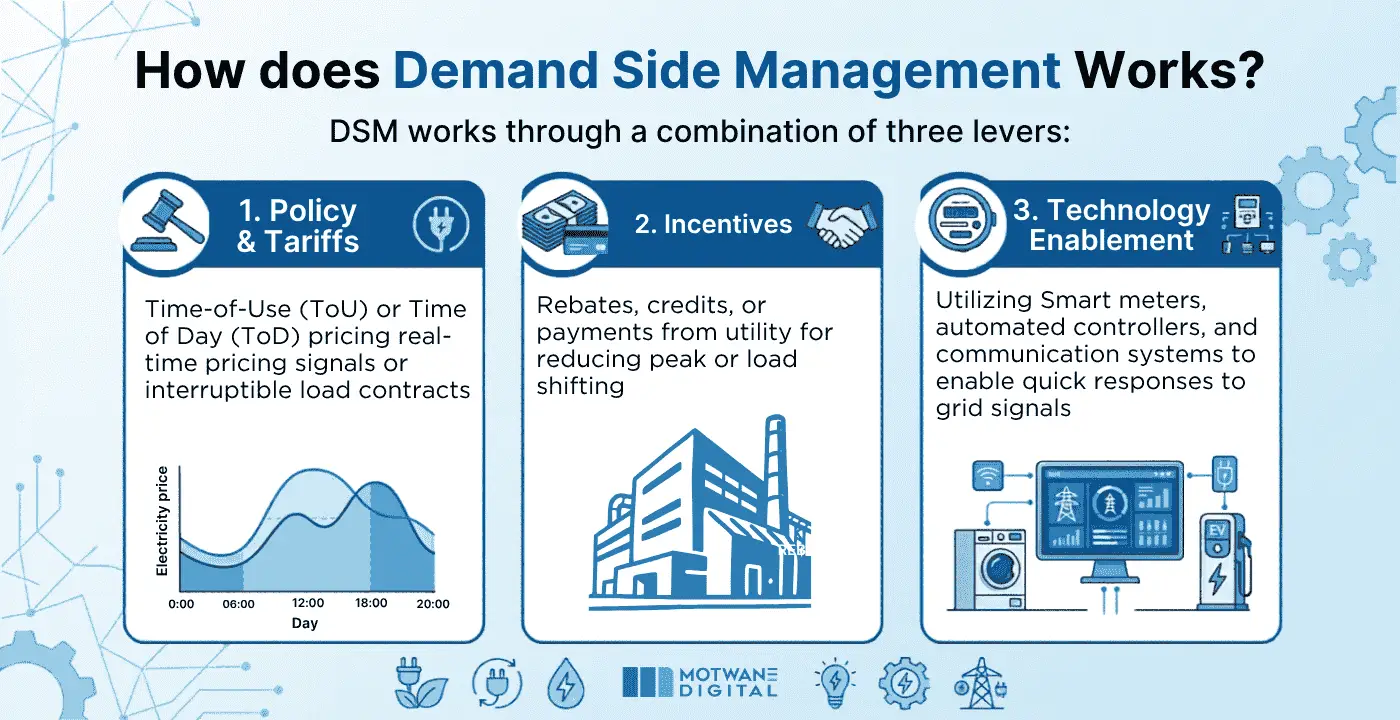
Advantages and Impact of DSM
For Industries
- Direct savings in terms of reduced peak demand charges and improved ToD tariffs.
- Access to utility incentives and rebates for participation.
- Improved competitiveness through predictable energy costs.
For the Grid & Environment
- Reducing the need for expensive peak power plants.
- Improving the integration of renewables through balancing solar and wind power.
- Reducing overall system emissions and increasing system reliability.
Regulatory initiatives (2026) in states such as Karnataka and Rajasthan are now more defined in the context of DSM, which has set performance-based incentives for DISCOMs, providing larger opportunities for large consumers.
What is Energy Management (EMS)?
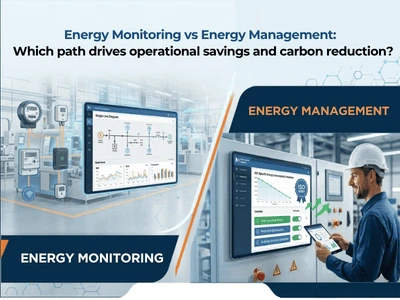
Energy Management, usually implemented through an Energy Management System (EMS), is a facility-level approach focused on monitoring, analyzing, controlling, and optimizing all energy flows behind the meter.
It covers grid supply, on-site generation (solar, DG sets), battery storage, and every major load in the plant. Accurate data from power quality analyzers, IoT sensors, and meters is the base for any effective EMS system.
Modern systems use AI for forecasting and dynamic adjustments, turning data into daily operational wins.
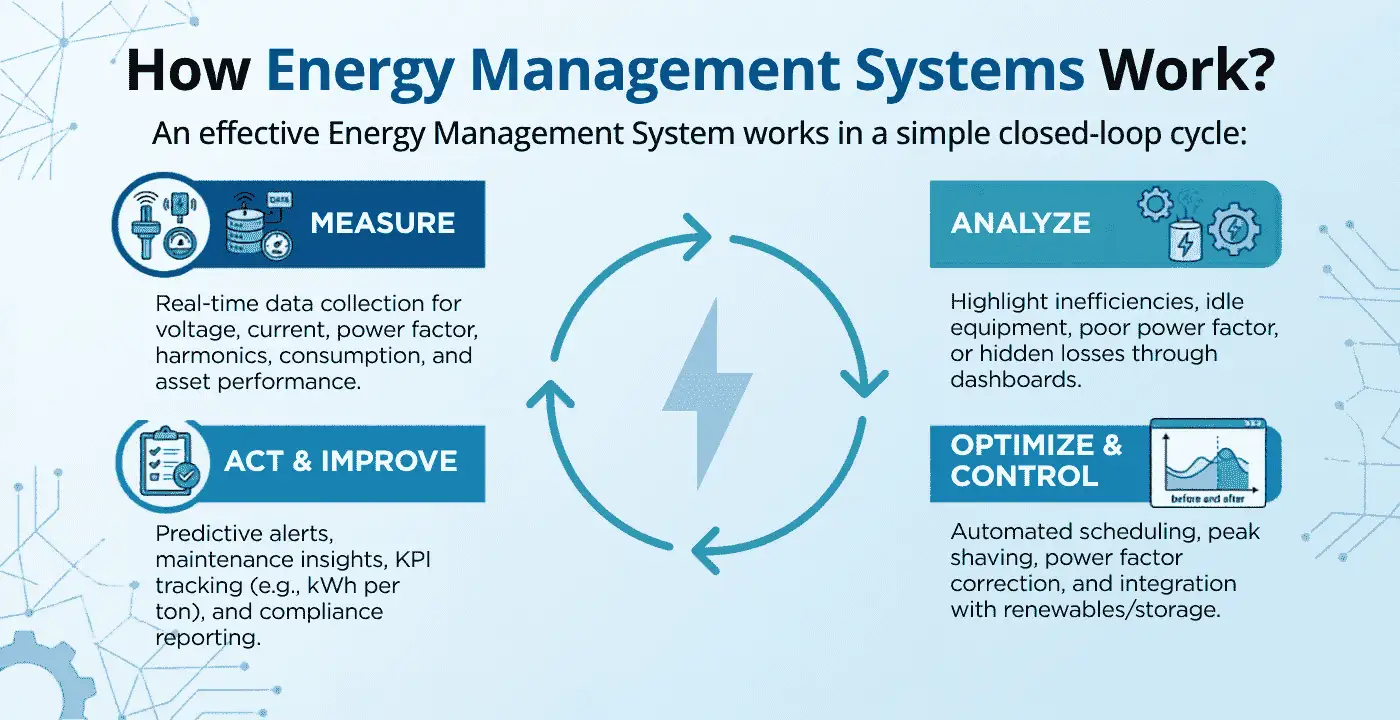
Advantages and Impact of EMS
Operational Gains
- Uncovers 15-25% hidden energy losses common in many Indian plants.
- Extends asset life through predictive maintenance and better power quality.
Financial & Sustainability Benefits
- Consistent reduction in energy bills via optimized scheduling and self-consumption of renewables.
- Stronger ROI on solar, Battery Energy Storage System (BESS), and efficiency upgrades.
- Easier compliance with ISO 50001 and Carbon Credit Scheme.
Facilities with mature EMS enjoy higher uptime, improved productivity, and data-backed budgeting.
DSM vs EMS: Comparison
Here’s a side-by-side view to remove the confusion:
| Aspect | Demand Side Management (DSM) | Energy Management System (EMS) |
|---|---|---|
| Primary Focus | Grid & utility-level demand shaping | Facility-level internal optimization |
| Scope | Consumer + utility ecosystem | Site-specific (plant or building) |
| Control | External signals & incentives | Internal monitoring & automation |
| Time Horizon | Program-based (short-term flexibility + long-term efficiency) | Real-time to daily operational control |
| Key Tools | ToD tariffs, Demand Response programs, rebates | Meters, IoT sensors, software dashboards, AI- Powered Analytics |
| Main Goal | Peak reduction, grid stability, flexibility | Total consumption reduction, asset efficiency |
When to Use What?
Prioritize DSM if you want to:
- Maximize tariff benefits and access utility incentives or rebates.
- Shift flexible loads (e.g., non-critical processes) without major internal changes.
- Implement demand response or flexibility programs under new 2026 state regulations.
Prioritize EMS if you:
- Lack real-time visibility into where and how energy is being consumed.
- Want continuous, automated optimization and loss reduction.
- Need predictive maintenance and power quality insights for critical assets.
- Aim for long-term efficiency and sustainability reporting.
Best Results? Combine Both.
An effective EMS provides the level of data and control required to effectively participate in DSM programs. Together, they create a smart and responsive energy strategy.
Where DSM and Energy Management Overlap
The two approaches are highly complementary:
- Energy Efficiency: Serves as a shared foundation.
- Demand Response: An advanced EMS can automatically respond to utility DSM signals or dynamic pricing.
- Load Optimization: An EMS delivers the precise control required for successful DSM practices.
- Sustainability & Renewables: An EMS maximizes on-site generation and storage while DSM aligns with broader grid/utility requirements.
In practice, industries that start with continuous monitoring (power quality + consumption data) build a strong foundation for both DSM implementation and internal optimization.
Smart Way for Industries
Demand Side Management and Energy Management Systems are not competitors instead they are strategic partners in today’s volatile energy costs and savings. DSM provides external benefits and grid-level advantages. EMS provides internal visibility, control, and sustained savings.
For manufacturing, metals, textiles, or any energy-intensive sector, integrating both helps reduce operating costs, support renewable integration and improve sustainability. It also helps industries to stay compliant with evolving regulatory expectations in present and beyond.
Need a detailed energy audit, power quality analysis, or help building a unified energy strategy? Our team is ready to support your journey toward lower costs and higher reliability.
Explore more practical insights on transformer monitoring, power quality improvement, and industrial energy optimization with us.