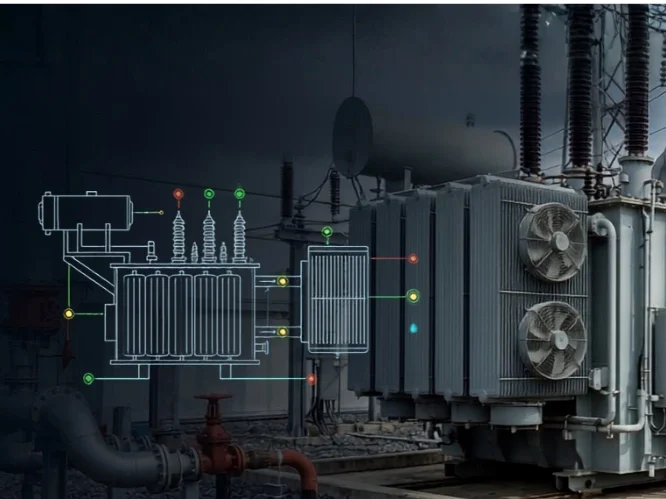
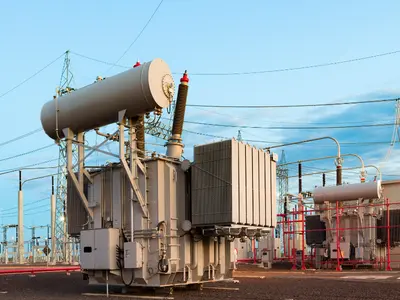
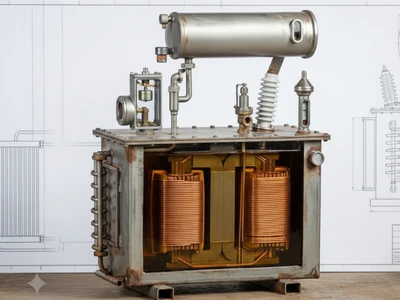
The important parameters that are crucial for the condition-based maintenance of the transformers:
1. Thermal Parameters:
Temperature is the major parameter that accelerates the insulation degradation. Every 8–10°C rise above design
limits can reduce the life of paper-oil insulation (Arrhenius rule of thumb).
-
Winding Hot-Spot Temperature:
The most critical metric. It directly proportional to insulation aging rate and loss-of-life calculations. Real-time hotspot monitoring (via fiber-optic sensors or calculated models) detects overload conditions faster than traditional top-oil thermometers.
-
Top-Oil and Bottom-Oil Temperatures:
The differential readings indicate cooling, sludge formation, or radiator blockages. Rise in top-oil temperature while maintaining constant loads shows inefficient dissipation of heat.
-
Ambient Temperature and Gradient:
Comparing these readings with internal temperature readings can prevent false alarms during heatwaves. It also helps in thermal modeling to support efficient dynamic loading.
These temperature readings directly help in AI-based prediction of asset life and health. If a transformer is operated 5°C above expected temperature for six months, it may lose 20 to 30% of its design life even if it appears to be in good condition during annual inspections.
2. Electrical Parameters: Detecting Load Stress and Imbalances
Electrical parameters provide information regarding how the transformer is really performing.
-
Load Current and Voltage:
Fluctuations in phase voltage or sudden rise in current indicate faults in downstream equipment. These parameters helps utilities to monitor safe loading limits.
-
Power Factor and Harmonics:
Low power factor readings or increasing harmonics in the current waveform shows increased eddy currents and temperature.
-
Neutral Current:
Excessive neutral current indicate earth faults or displacement helping to detect mechanical stress early.
3. Chemical and Insulation Parameters: The Window into Internal Health
Dissolved Gas Analysis (DGA) remains the premium standard for early fault detection, but online systems now deliver it continuously rather than once or twice a year.
-
Dissolved Gases (H₂, CH₄, C₂H₄, C₂H₆, C₂H₂, CO, CO₂, O₂, Nr₂):
Each gas profile indicates specific faults like, hydrogen for partial discharge, acetylene for arcing, ethylene for high-temperature thermal faults.
-
Moisture Content in Oil:
Water accelerates the degradation of cellulose. Real-time ppm levels detected by online moisture sensors correlate to temperature.
-
Oil Acidity, Dielectric Strength, and Breakdown Voltage:
Increased oil acidity indicate oxidation reactions. Decreasing dielectric strength indicates contamination or aging by-products.
Typically, only near to 25% of faults are detected via offline oil test results. Continuous DGA plus moisture monitoring detect the remaining faults showing warning signs weeks or months earlier.
4. Mechanical and Operational Parameters: Beyond Oil and Heat
Mechanical integrity often goes unnoticed until it’s too late.
-
Partial Discharge (PD) Activity:
PD detection by ultrasonic or UHF sensors detects voids, cracks, or contaminated insulation. PD trends for magnitude and PD pattern can help to differentiate between PD occurring on the surface, and PD that is critical, occurring inside the transformer.
-
Bushing Capacitance and Tan Delta:
Online bushing monitors can track changes in capacitance (indicating the presence of moisture or insulation degradation). Tan delta monitoring provides early warnings of the risk of explosive failure.
-
Oil Level and Tank Pressure:
-
Vibration & Acoustic Signs:
Loose windings or an issue with the cooling fan often causes vibrations that cause noise or failure.
Sudden drop or spike in oil level/pressure can indicate leaks, over-pressurization, or malfunction of the Buchholz relay.
Modern monitoring systems correlate vibrations with load current and temperature to detect actual mechanical faults from normal operating noise levels.
5. Environmental & Auxiliary Parameters: The Often-Overlooked Context
Ambient humidity levels, cabinet temperature, and GPS location provide reference to readings such as coastal corrosion concerns or high-pollution zones. Here the status of cooling systems is essential in order to properly understand thermal parameters.
Integrating Parameters for Actionable Intelligence
One parameter cannot tell the exact condition of the asset. It is the combination of correlated parameters that provides actionable intelligence, for example:
PD level + moisture level increase = insulation breakdown in progress.
Actionable weekly reports that incorporate all of the mentioned parameters along with historical trends and offline test results, provide a clear diagnosis. Using this, moving from only numbers to actual maintenance actions becomes simplified.
Conclusion
Effective and successful transformer monitoring is not only limited to the amount of data collected, but also about the continuous and accurate measurement of the parameters. By doing so, transformer life can be extended by years, downtime can be reduced, and operational costs can be optimized.